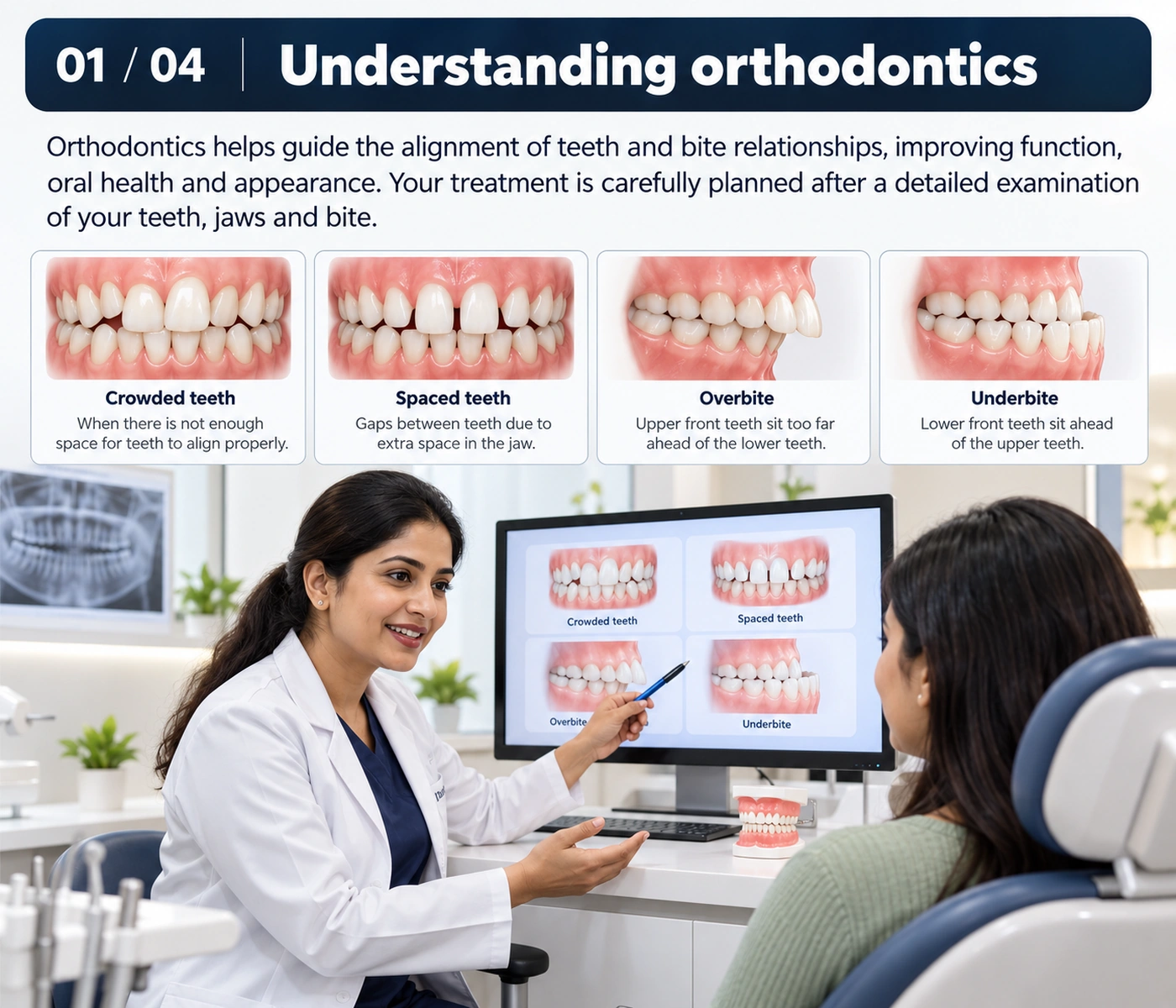
Educational artwork under clinical review: In the first illustration, horizontal front-tooth overlap is labelled “overbite”; the precise term is overjet. Orthodontic appliance availability and suitability must be confirmed individually; the generated examples and outcomes are not promises.
Dental care / Visual education
Why orthodontic treatment may help and what options exist
01 / 04Understanding tooth alignment and bite concerns
01 / 04
Understanding tooth alignment and bite concerns
Orthodontics addresses tooth alignment and bite relationships. Crowding, gaps, protruding front teeth, crossbite and other concerns require clinical assessment rather than a diagnosis from a picture. A horizontal protrusion of the upper front teeth is called overjet; overbite means vertical overlap. This corrects terminology simplified in the first illustration.
02 / 04
Reasons to consider orthodontic assessment
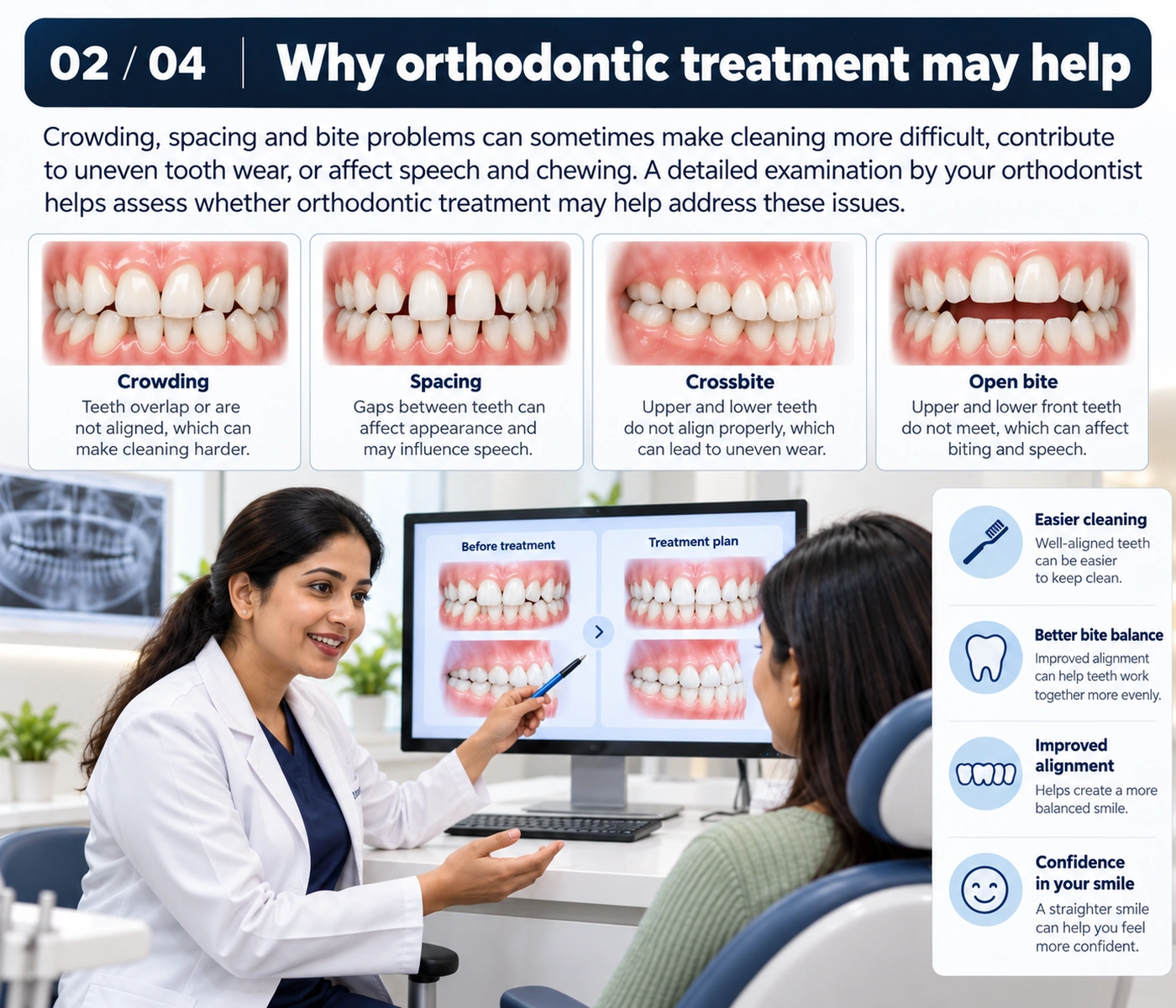
Crowding and some bite problems can complicate cleaning, contribute to abnormal tooth wear or affect chewing and sometimes speech. Not all irregular teeth need treatment. The clinician assesses teeth, gums, jaws and function before explaining whether orthodontic care is appropriate and what improvements might be realistic.
03 / 04
Comparing fixed brace systems
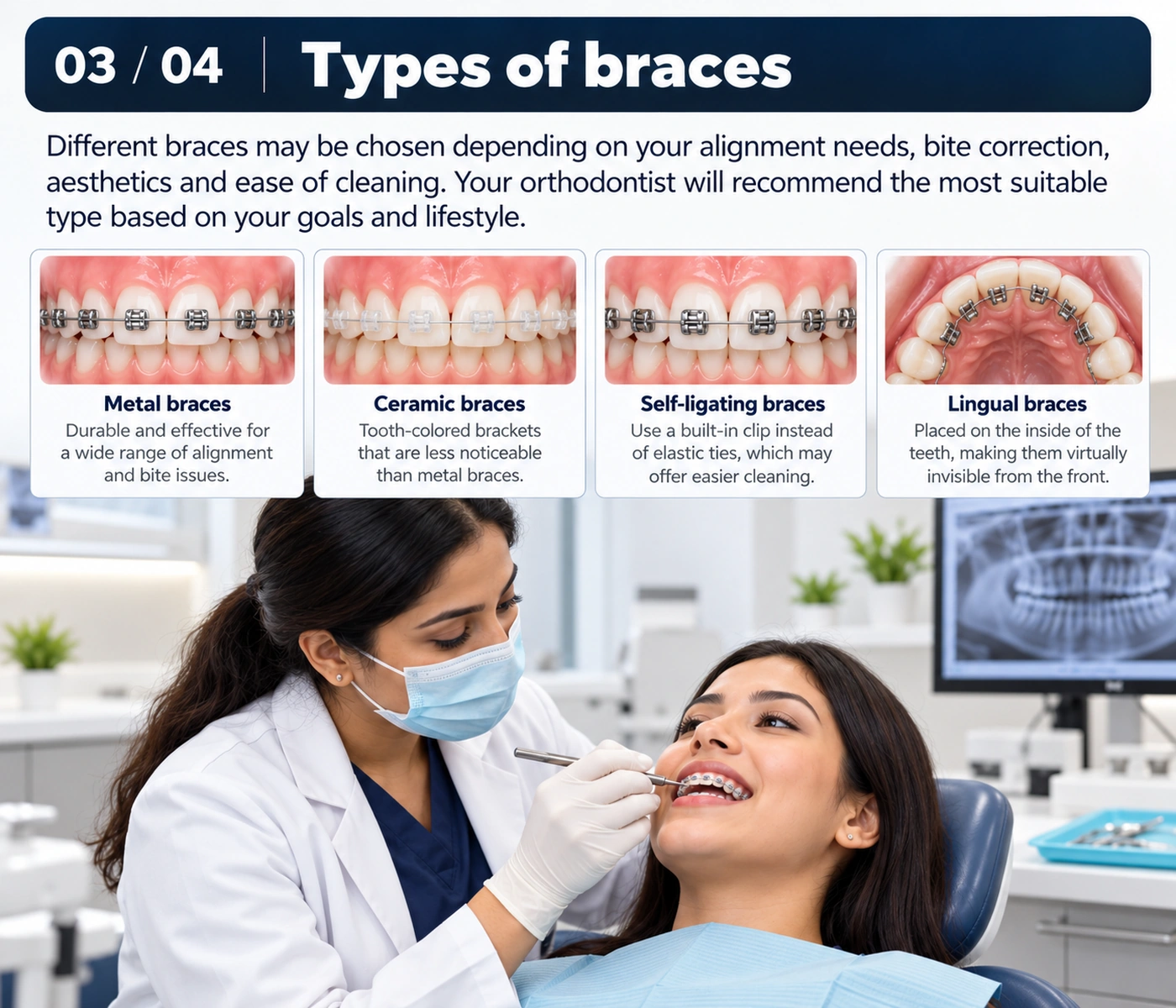
Examples include conventional metal brackets, tooth-coloured ceramic brackets, self-ligating brackets and lingual braces attached behind teeth. Every system has trade-offs in suitability, visibility, cleaning, cost and specialist availability. The illustrations do not confirm that all types are provided at this clinic.
04 / 04
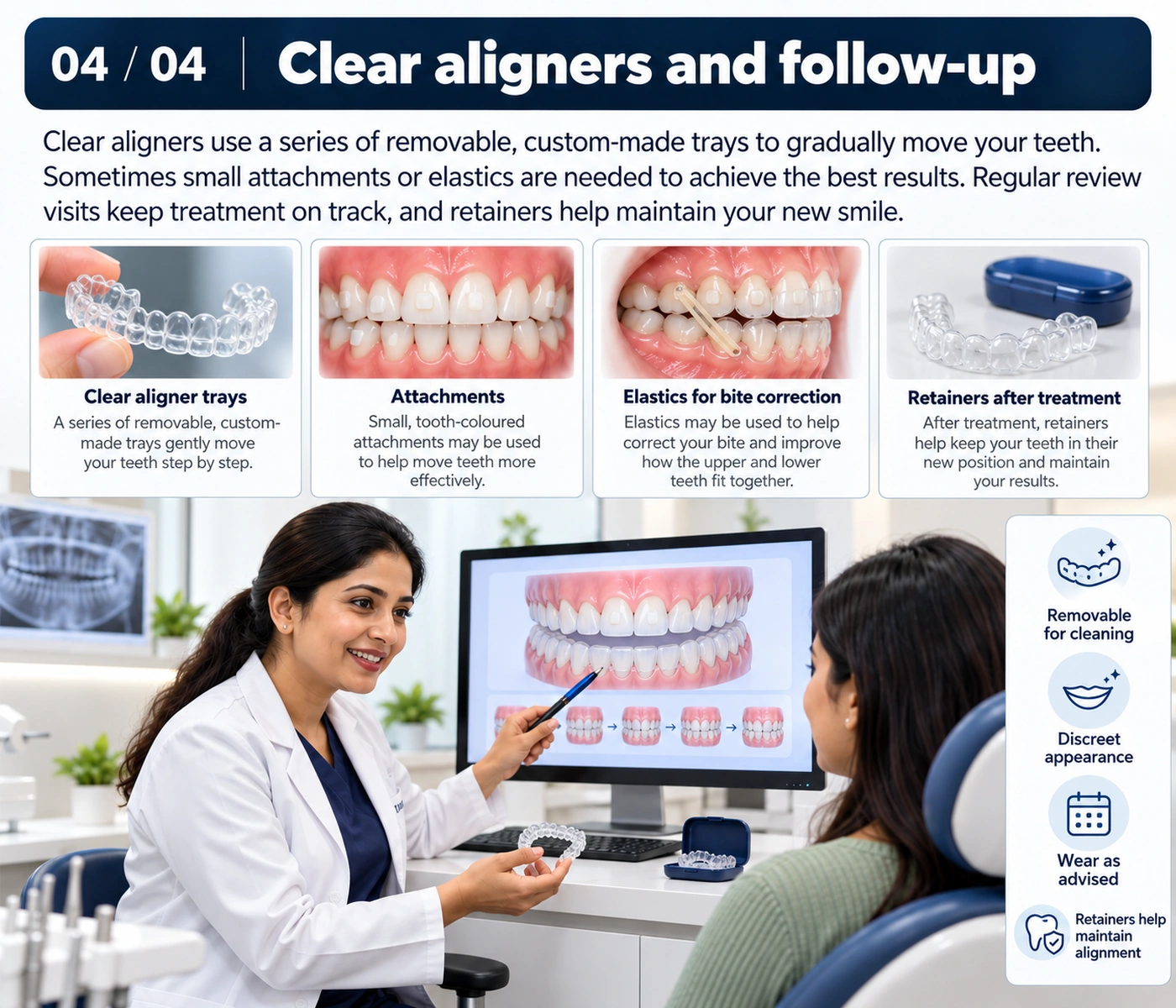
Clear aligners, retainers and follow-up
Clear aligner therapy usually involves a series of removable trays, with attachments or elastics for selected movements. Results, length of treatment and wear instructions vary. A suitable retainer—fixed or removable—may be recommended after active treatment to reduce relapse; ongoing monitoring remains important.
AI-generated educational illustrations, not patient photographs or recordings of actual procedures. Individual treatment and outcomes vary.
01 / Understanding symptoms
When to ask for an assessment
Crowded teeth or gaps
Crossbite, open bite or deep bite
A child's developing jaw alignment
02 / Discussion topics
Tests and treatments to discuss
Your clinician will explain which approaches may be relevant. Procedure equipment, location, accreditation and availability must be independently confirmed.
Orthodontic assessment
Metal braces
Ceramic braces
Self-ligating braces
Clear aligners
Lingual braces evaluation
Retainers
Early interceptive orthodontics
Palatal expansion
Space maintainers
Functional jaw appliances
Crossbite correction
Open bite correction
Deep bite correction
Crowding and spacing correction
Orthodontic miniscrews TADs
Orthognathic surgery planning
03 / Clinical assessment
What happens at your consultation?
After assessing the bite, oral health and records, the clinician discusses appliances, anticipated stages, monitoring and retention.
04 / Informed decision
Suitability, alternatives and safety
Some cases need specialist orthodontic or jaw-surgery collaboration. Treatment duration and result cannot be guaranteed.
Clinician
Dr. P. Rama Devi
BDS, MBA (HHCM). Further investigations or specialist involvement depend on your assessment.